The land over which the song passes

Sluggish and sedentary peoples, such as the Ancient Egyptians– with their concept of an afterlife journey through the Field of Reeds– project on to the next world the journeys they failed to make in this one. 
– Bruce Chatwin (The Songlines)

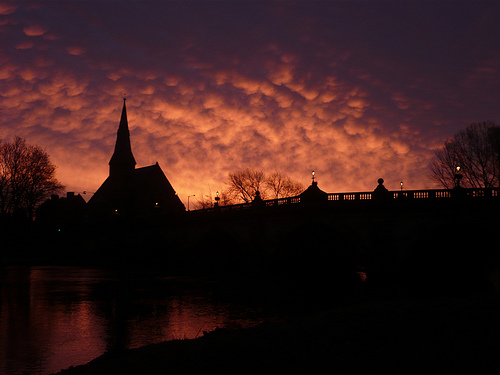
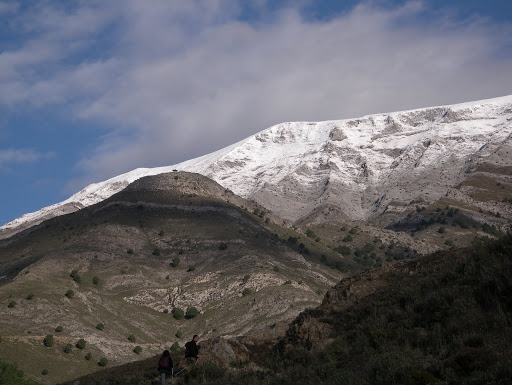
The mountain in the picture is Maroma, a 2065mt beast which sits above the village of Sedella in Southern Spain. My dad’s rented a place there for the summer and invited me out for some ‘bonding’. 

He lived in this part of Spain for a couple of decades and conducted guided tours up this mountain – which is how he met his Dutch girlfriend, triggering a move to Amsterdam where he’s been for about 15 years. He’s increasingly missed the Spanish landscape.
It’s two decades since I did any serious walking or climbing, and it wouldn’t have occurred to me to undertake anything other than a couple of medium-effort walks had my dad not said: the area has many good walks at a lower level for all ages, so I am hoping I may be able to tempt you on one or two.  
Red rag to a bull! Does he think I can’t manage the whole thing?
So now I’m determined to do all 2065mt of it and shall report back in due course with smug looking shot of Me Perched At Summit. I have thrown back the red rag: actually I’d like to climb to the top, but I’ll understand if you don’t feel up to it…
My dad has always explored – he’s canoed, climbed and hiked his way around the world, from the Sahara to the polar regions. He’s in pretty good shape for a guy of 72 or 73, whatever he is (we don’t do birthdays). I was always surprised, given how alike we are, to have not inherited his wanderlust. I figured maybe I just did it via my imagination, in my writing; that travel doesn’t have to be a physical thing – it’s a concept, a state of mind, a way of thinking… it’s a curiosity.
Now I look at the Chatwin quote above and I wonder… is that enough? 

Perhaps writers are also sluggish and sedentary people at heart, projecting into our fiction the journeys and adventures we fail to take for real. Perhaps we think we’re more open-minded than we are. Perhaps we feel we’re achieving more than we are. Perhaps we’re so lost in the pretence, we can’t even see it for what it is.
Is it enough, that armchair curiosity? I always thought so… now I’m not sure.  
I am a woman with Missions. But I’ll start with that mountain…

Some kind of Lovely…


Thanks to Samantha for the blog title, which is a chapter title from a favourite book and which she thought would suit this post… and it does, perfectly!


This weekend my lovely daughters gave me gifts, for no other reason than they’re Adorable Beings.


Sam drew me this gorgeous name plaque which she says represents the ‘writing me’. 

Judging by the last picture, I think she has more confidence in my future than I do… ha!


And Jess wrote this beautiful little poem. 


In case you’re wondering (as, indeed, was I), the unfortunate Ken mentioned here is that of Barbie fame… Jess wishes him dead. 

Some may read that and think I’ve spawned a monster – but I know I’ve just inflicted upon the world yet another writer. 


We also asked the Delphic Oracle what is the meaning of life? It gave us this answer:

Let there be, for a time, no driving aim;
No mission, no goal, no fury’d intent.
Notice the hours — how they lengthen and breathe:
Like dust in the sunset, thy soul’s content.


It’s not often the Oracle spouts anything other than amusing vague ramblings, but I think this is actually quite profound… and might be its finest effort yet. 


dawn

it’s after five and i went outside for a smoke listened to the bird noise that people call singing but which is actually aggressive shouting defending territory selfishly like drunks on friday night are you lookin’ at my bird or dogs pissing on lamp-posts and i haven’t been sleepless for a while but five a.m. is better than four which is depressing and leads to negative thought because five is more optimistic somehow and being awake before others oddly satisfying even when a person doesn’t get anything done other than thinking just thinking and wondering whether typing it out constitutes writing or wrist-slashing and whether indeed it matters either way but mainly just thinking about the lighter mornings and how five a.m. differs season to season country to country person to person and how for me dawn would really be better slept through until at least the summer when birds shout slightly nicer songs and my smoking chair isn’t covered in rain

In here

In here
I am words on the screen
Your own voice speaks me
A thought, a reminder, a concept
A companion called up and
dismissed at will
I am the ghost of something lost
Closer than where it was left
yet equally intangible
In here
I am more you than I am me
Static, silent, contained, filed
Anyone and no one and everyone
I am read, scanned, misread
Remembered, forgotten
Searched, deleted, repeated
Ignored
Outside of here I am a person.

She wandered lonely as a cloud…

My Point of View is in crisis.

After a year of starting third person novels, over-plotting, over-thinking, losing interest, abandoning them, I was finally revisited by my Muse and began a new book. In first person.

What it says about my ego, I don’t know, but I’m lured by first person voice as a reader and as a writer… and yet we’re told, endlessly, how debut novelists should stick to third. 

So I’m experimenting with shifting this new book into third – now, before I get too far in and such a change would be a pain – and comparing the results of the first 4k words in each POV.

Something is clearly lost – a sense of moodiness, obviously the closeness – and yet I figured there must also be gains. Distance has its own value, moodiness is a matter of word order – there’s more to change than just putting “I” into “she” – and, of course, third person means no restrictions on what the narrator can see. 

But even though I think the gains do outweigh the losses, I can’t switch off that inner first person and am still thinking through story elements in that voice. I’m a Method Writer – need to be firmly in the head of a protagonist to be able to enjoy writing them, even when they’re dark, miserable and being them means teetering on the edge of their abyss…

Oh. Yes. Hang on… I’d forgotten how horrible it got writing The Sky is Not Blue, sat in a dark, windowless shed, smoking a thousand ciggies and drinking way too much wine whilst the rest of the world was outside enjoying the sunshine.

Third person it is then. Let sanity be mine.


Certain dark things

So much fluffy, pink, flowery stuff around today. 


I shan’t add to it. But neither shall I bang on and complain about it – nobody likes a killjoy..!


However… I prefer a little darker, less sickly – and perhaps thus more truthful – take on love, myself. 

Like this one:

I Do Not Love You (Pablo Neruda)

I do not love you as if you were salt-rose, or topaz,
or the arrow of carnations the fire shoots off.
I love you as certain dark things are to be loved,
in secret, between the shadow and the soul.

I love you as the plant that never blooms
but carries in itself the light of hidden flowers;
thanks to your love a certain solid fragrance,
risen from the earth, lives darkly in my body.

I love you without knowing how, or when, or from where.
I love you straightforwardly, without complexities or pride;
so I love you because I know no other way

than this: where I does not exist, nor you,
so close that your hand on my chest is my hand,
so close that your eyes close as I fall asleep.

Ships passing

I was married to a man who was often away, and when home was rarely present. If we were ships passing it was on separate seas, in different time-zones, each oblivious for the most part to the other’s existence. He did not have to be elsewhere. He chose it. Things perceived caused an anger that became destructive – he had a need to apportion blame – and I’d grown not only used to my own company but happier with it.

On the occasions he and John met over the summer, he would hover at close distance as John worked hard on some manual task – fixing a fence, digging out rhododendron roots, hauling stones for a rockery I’d thought might be nice near my study window – and he would use his business suit as both excuse and weapon. He made jokes about unpaid labour, about those who command and those who serve. Inappropriate jokes, meanly delivered, which he’d then soften with the promise of a pint later at the pub.

“You make an unlikely couple,” John said to me once. I asked him, unnecessarily, to elaborate. But he merely shrugged, shook his head and didn’t mention it again. 


The summer passed in warm routine, despite it all. The garden took on a civility perhaps not known in some two hundred years – perhaps never. Weeds in retreat, the reach of shrubbery checked, a perimeter now clearly enclosing a cropped lawn and the handsome rockery of Alpines marking its centre point. The nights closed in sooner. The tourist season ended. Those fleeing for warmer winter retreat did so. Those left behind eased out of their summer smiles as if casting off tight shoes. By November my husband was home almost constantly. No reason was given. I assumed he and his latest fling had come to grief. Phone calls were made and taken outside in the car and I wondered how stupid he thought me. Yet, still, I hoped they’d patch things up. The new routine was stifling.

The Falconer

It was a time of great unhappiness. Dark clouds occupied more of the sky’s expanse than could be dismissed as a passing mood. The sun seldom broke through long enough to be trusted and the wind’s relentless effort failed to blow away the gloom. I took comfort in long beach walks, the company of angry waves suiting my disposition far more than that of any human.

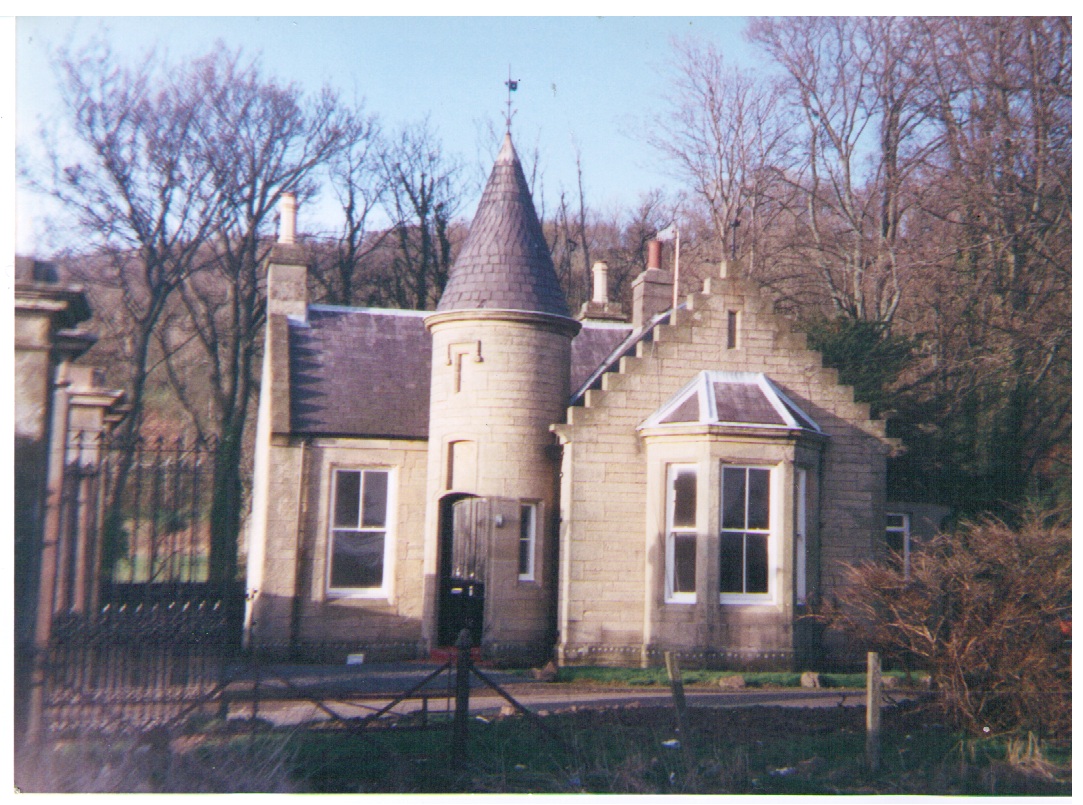
I lived in the grounds of a castle. In the exit lodge to be precise. A small Victorian addition, its humbleness moderately deflected by the turreted entrance and high-windowed façade. Bats rightly inhabited the turret, their young emerging and learning to fly in summer’s dusk, several falling foul of dark windows as they returned, aiming for the eaves but failing in their novice attempts. Inside was cramped: three original rooms with no corridor, and an ugly rectangle tagged on sometime in the sixties to house a kitchen and bathroom. I worked from a small study which doubled as a guest room, though there were rarely guests. It overlooked the rear where pheasants came to hide from the shoot, to breed in the tangle of unkempt rhododendron bushes. The garden was wild. I liked it that way.

In summer, coachloads of tourists would queue at closing time outside the lodge, waiting to exit the gates onto a perilous bend of the coastal road. They would peer in through the windows as though my home was part of the attraction, as if to get their money’s worth. An American couple on foot once stuck their heads into the open sash and proclaimed the living room cute. The castle was a part-time whore by modern necessity; open for public tours, available to hire for weddings and conferences, its laundry and stables converted into shop and café, grounds used for fêtes, markets and sporting events, its remaining forests harvested and prepared for sale in the on-site sawmill. The family lived in two or three private rooms with a scattering of inherited treasures and the stories of 800 years.

I did some freelance work for the Estate Manager – a bad-tempered man who wore tweed as an imperative and whose manner, as is perhaps often the case, far outstretched that of his employer in its pomposity. The Earl himself was charming, fascinating and never happier than when wandering his estate, mingling with staff and tenants. He saw us as family. We used first names. Once the gates closed in the evening, the castle and grounds were quiet, they were ours. There was a necessary camaraderie. It’s not easy watching strangers nose through your life.

His children were away at school much of the time. His wife was rarely there, a brief flash of silver Mercedes bumping too fast up the drive once or twice a month. She never stayed. Rumour said she’d run off with a female lover and spent most of her time in the city. In a small community this was entertainment. The Earl not only had to contend with a crumbling home invaded by ignorant cultural list-tickers, but also an unwanted public sympathy and mocking whispers behind his back. The dignity of generations and strain of preserving for the future drove and sustained him, I think. He was busy. He was cheerful.

John arrived on the estate the second spring I was there. He was hired as falconer, to perform for the public during open season and undertake labouring jobs in the winter months. He moved, with his unfeasibly large family, into the woodman’s cottage, tucked privately away in the forest out of sight of the visiting public. But though others envied him the location, with five stepchildren of varying ages and one young son there was little room within its walls to move, breathe or be heard and he spent most of his time outside tending to the birds or walking his dog.

We met – fortuitously at first, later by design – on the track up through the forest early evening, or along the pebbled beach in the morning, our dogs becoming friends and forcing a conversation which grew in breadth and depth until we followed suit.

Theoretically I did not live alone either. Yet as we moved beyond those early reluctant conversations – the dog talk, the weather, the tides – came a sense of needing to harness urgency, to temper all that clearly could be said, to adopt a false pace. We were equally starved and this unacknowledged truth enveloped every word.

“I come down here sometimes at night,” he said, kicking pebbles with a dusty working boot as we walked along the beach. “Sit in the dark over there on the wall, listen to the waves. Try to guess where the waterline is, whether it’s coming or going. You can tell, it sounds different. Retreating tides are best.”

He was strong and adaptable. He fixed things, made things, his hands scarred by capability. He worked hard in all weathers, whistling unrecognisable tunes and never once did I hear him complain about cold, wet or heat. I liked arriving unseen when he was busy with the birds, or erecting yet another section of aviary, or digging up belligerent weeds to create a patch of ground for low perches. I’d watch until he sensed I was there, or his wife came out of the house with a cup of tea and called a cheery greeting, breaking the silent contemplation.

She became less enamoured of my visits over time. Stopped sitting outside with us on summer evenings, drinking wine or beer, smoking and talking. She found the conversation too speculative, thought we talked too much, that any talking was too much. She went inside to watch television with the kids and eventually I stopped calling round. Eventually I moved away.

I’m forever drawn to the poets. Those who present a front of strength but who harbour inside a melancholy will; a wistful philosophy; an ability to dream. These moments are the paths seen but not taken. They are the unexplored chances, the ‘what-ifs’ upon which our present is judged, our future formed. These moments become the basis of most regret.
The poetry of pastry…

I attract old men. Specifically, I attract vagrants and those for whom vagrancy is but one misplaced step away. I don’t know why this is so, but can guarantee if I am alone and within 20 feet of such a man he will soon gravitate in my direction and strike up a conversation.

I’ve never yet met one of these disparate souls who didn’t fascinate and bring something to my day – my life even – that would otherwise not have existed.

This morning I’m sitting outside my favourite café in The Square. It’s market day – the usual stalls selling interesting cheeses, organic meat, cakes, local honey and the delicious smell of Gloucester Old Spot hog roast. It’s wonderfully busy, a perfect people-watching day and I, with coffee and pastry to hand, am observing the crowd and penning a poem.

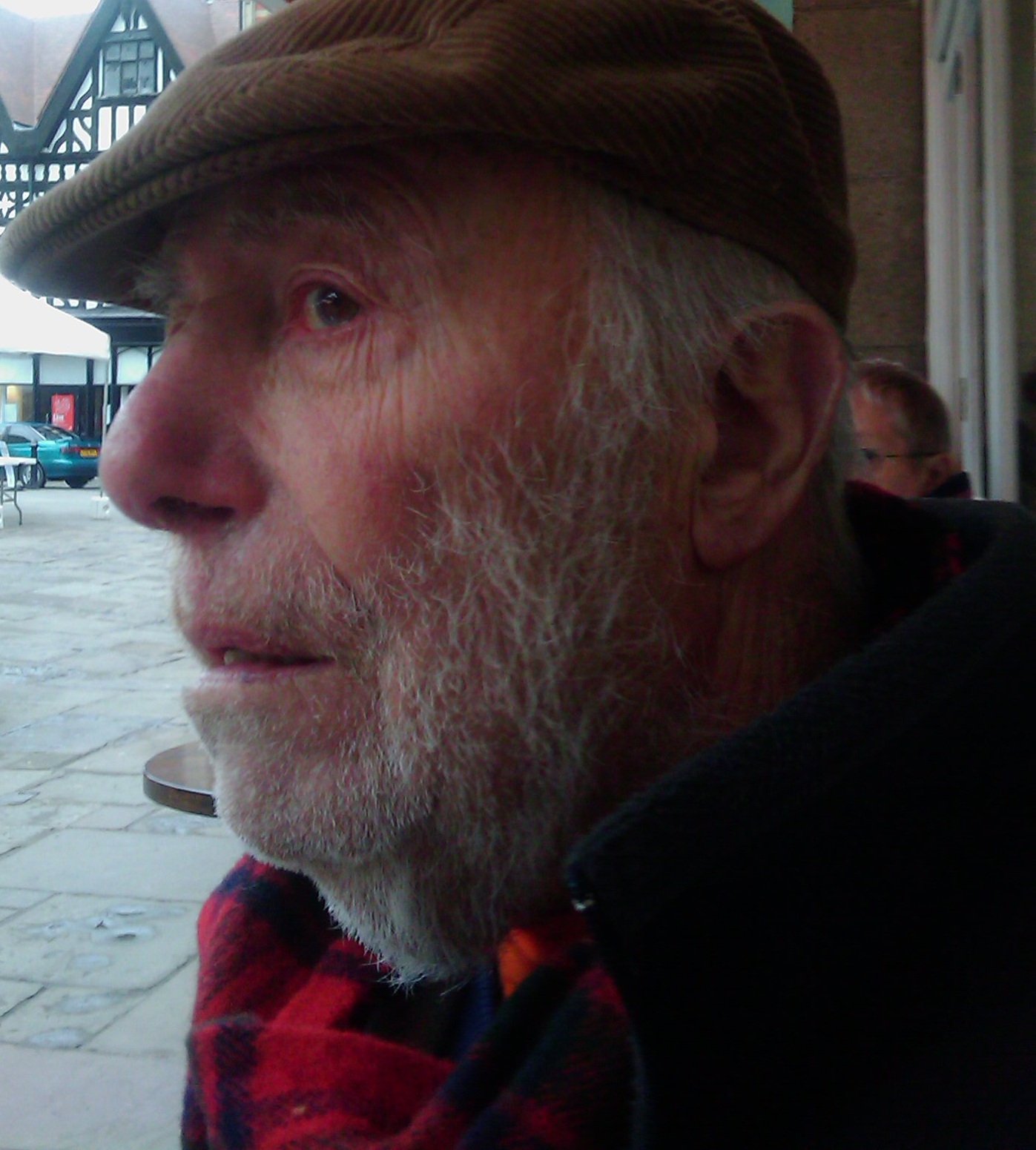
The rough-looking chap in the picture shuffles into my line of vision. He watches me for a few seconds and I just know he’s going to talk. He points to one of the market stalls, have you tried any of those cheeses?

I tell him no, I haven’t, but am sure they’re lovely.

I know food, he says, I’m a chef.

I don’t believe he’s a chef, of course. He’s grubby, unshaven, smells strongly of whiskey and is carrying a small bag in which I assume there’s a bottle. But I smile and pass comment on how much I also love cheese and we chat for a minute or two about port with stilton and suchlike.

What are you doing? He asks, pointing at my notepad.

I tell him I’m writing a poem.

Ah, a writer, eh? What do you think I do? He grins. He has few teeth.

You’re a chef, I tell him.

How did you know that?

He’s genuinely amazed. I laugh and tell him I’m observant. I tell him it’s obvious.

Shift your bag, he says, pointing towards the neighbouring chair, I want to sit, have a chat.

And so we sit and he talks. He’s an absolute gentleman, quietly spoken and full of charm. He tells me specifically he’s a pastry chef and, as he describes the skill of creating light filo pastry, how to raise the perfect pork pie, and runs briefly through the various hotels in which he trained and worked, his conversation scattered with beautifully pronounced French, I realise how wrong I was. Tony is, indeed, a pastry chef.

Periodically he lifts his little bag and takes a not-so-surreptitious mouthful of whiskey from the bottle. He gives me a recipe for parsnip wine and insists I write it down. He moves onto his life situation – his dead son, his absent wife and daughter, the collusion of life events that led this Swiss-trained pastry chef to a dead-beat hotel kitchen and dubious but comfortable relationship with its landlady. 

He tells me he writes poems to his dead son.

He pauses. We sit quietly smoking for a few minutes.

Well, that’s it. That’s my life story.

And then he cheers up and tells me he has some racing tips. No, no, I say, I have to keep away from the horses, I have an inner gambler who must be constrained. But he insists. Good tips, he tells me, I’ll win a lot of money.

And when you do, he says with a wink as I get up to leave, we’ll elope.

Can’t say I’ve had a better offer this week. 

Clucking Mad…

My kids’ school currently has an initiative running to encourage children to arrive on time.

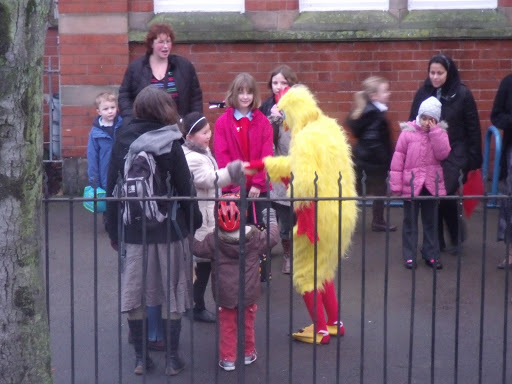
This involves a giant chicken parading the playground and shaking the hand of the early-bird kids.

Quite why children should be motivated by the chance of being accosted by an unconvincing oversized Sunday lunch is beyond me.

And it’s beyond my kids too.

In fact, it falls into some mysterious spot between ludicrous and sinister to see a grown man, shivering in a chicken costume as he struts around a primary school playground, shaking hand/wing and posing for photoshoots.

And it’s had the reverse effect for us. We live directly across the road from the school and so my girls have the advantage of being able to look out of the window, wait until the chicken is otherwise occupied, and then quickly – just before school bell – rush over and slip in the school gates without it seeing them.

“I think it’s only going to be here another couple of weeks,” Jess said this morning. “Thank goodness…”