Driftwood

A string of coloured bulbs lights a safe path round the harbour in darkness, its sharp hues too brash for the faded woodwork of the boats below. The shadows cast make the small seem big, distort the familiar into the strange, bleed colour out of the world. Once again I’m struck by the oddity of hating silence but loving the dark.

But it is not silent yet. The night is still young in relative terms, and this is the best time of the day. 

Pubs and restaurants compete for the lucrative summer trade with colourful chalkboard menus offering home-cooking, casket ales, families welcome, and the air is rich with the smell of cooling seaweed, beer, food. Doors open periodically; laughter, music and cheerful goodbyes emitting from the yellow glow; a cacophony of accents of those well-fed and softened by alcohol. Car doors slam, engines rev and behind it all the rhythmic beat of the retreating tide breaking gently against the outer harbour walls.

Pat and I used to love hanging round this part of town on Friday nights. Before Spencer. Before we were old enough – or nearly old enough – to be in that yellow glow ourselves. We’d sit on the edge of the harbour wall, dangling our legs and listening to the slow chug of cars down the narrow streets, live music drifting on the summer breeze, tourists calling out loudly – as though everyone were on holiday, as though none need rise at dawn to face a working day – whilst locals sighed, took the money, tolerated the intrusion.

We both liked and despised them. The visitors. We were never really sure.

When Pat was around I didn’t fear silence, though it was rarely present. There wasn’t a topic we didn’t discuss, at some point, over those years. At least that’s how I remember it, though the individual conversations themselves are gone. I remember fragments more than anything, and the sense that they represented the norm. We talked. It’s what we did.

“What are you thinking about?” Fen asks.

I laugh, though the question irritates. I can see the imbalance clearly at these moments. I know he would like me to stay.

“Nothing really. Just someone I knew when I was here.”

“And his name?”

I laugh again.

But his question makes me think about Spencer and I don’t want to do that. I want to think about Pat. To work myself up to the point where I can perhaps walk up the lane to the lifeboat house. Can perhaps go where I know I must eventually go.

Though not yet. I’m not ready.

But thinking about one invariably conjures up the other. It isn’t fair to blame Fen.

“She. Pat. A friend.”

“Ah. Does she still live round here?”

This is how it goes. The start of destruction. I will tell him about Pat – I need to tell someone about her – and he, in turn, will tell me things I want to know but shouldn’t. We will explore the depths, the most intimate secrets; will pick each other to the bones. And then we will realise there is nothing. And I will feel this first, because I am expecting it.

But it matters not. I’m leaving anyway.

It’s funny but I’ve never told Mervyn anything. Thirty four years and nothing. And he’s never asked. Maybe I always knew he was for keeps, in some form or another, and so was worth the effort of discretion. But, as I say, our edges are irregular and he too practical a man; solving problems when all that is needed is an ear. He would have tried to find Pat, at a point when I did not want her found.

But I want her found now.

Fen is a practical man too. So I tell him. I explain how life is when you love and hate in equal measure and with a passion that destroys everything it touches. How the aftermath of such intensity is endless. How this is obviously my interpretation. This is what I see. What I feel. This is neither true nor false – it is perception; a photographer’s view of the world.

And I tell him what I think Pat did. Jumped. Flew. Whichever.

The silence is tangible.

“She must have died,” he says, eventually. “You realise that?”

We walk to the beach. It’s darker there, although the moon is almost full and the sky clear. I know if I was here alone, in silence, more of the past would be audible; that it would help recover the Something Else. But equally I need Fen to keep talking. I don’t know why. I wonder what forgotten thing is waiting for me – what it is that I just cannot reach out and touch. Did I push Pat? Is that the horror I can’t now recall?

“Do you think I might have pushed her?”

He squeezes my hand. “I don’t know, but I can find out.”

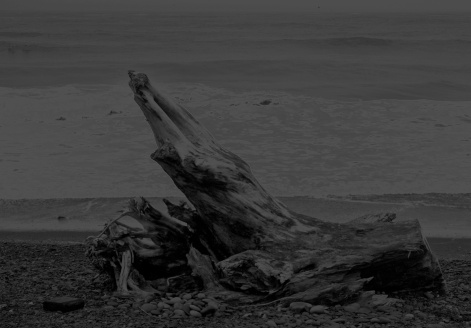
Ahead we see a large shape on the beach, a piece of driftwood, in silhouette against the shine of the sea. Fen says it looks like a person climbing out of the sand, one arm raised, pulling on an invisible rope. I say it looks like someone sinking into the earth and waving in desperation, hoping anyone passing – maybe us – will hurry forwards and grab its hand. Then we walk another twenty paces or so and it no longer looks like either.

~ The Sky is Not Blue
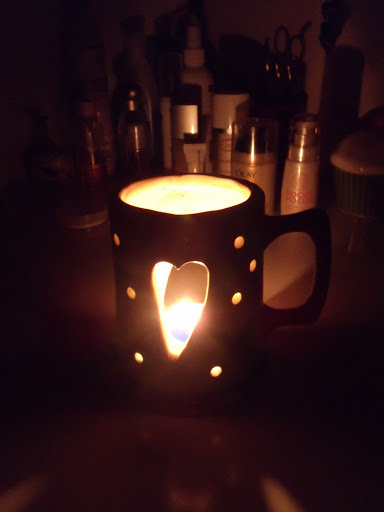
For a dark hour or twain…

I’m sitting here in almost-darkness, with a house that’s cooling rapidly – our third power cut this week, each lasting several hours. Power failure is supposed to be one of those rural pastimes we gave up when we moved to town.

I do usually enjoy power cuts. Being isolated from the virtual world, for one thing, can be very restful. And I love sitting by candlelight in front of the fire, in silent contemplation – in fact I can happily daydream hours away watching flames.  

But it’s Sunday evening. There are school uniforms to be ironed, children to be bathed, their hair needs washing… I need washing! And I have work to do, for which I need a laptop on mains supply and not its ludicrously ineffective battery back up.

Added to this is the fact that we’ve run out of logs and can’t get a car out of the driveway to replenish the stock because the gate is electric with no manual override. So… no cosy fire, only one candle left, laptop battery almost dead, work stacking up and children dishevelled and grubby for school tomorrow. It’s not good.

Power cuts in town are different too. Not as seemingly expansive or silent as those in the country. When we lived just outside a village, I’d look out of the window and see absolutely nothing. There was something lovely and soothing about that. Here, I look across the river and see that the town centre is lit up (a sensible person might just grab her purse, in fact, and head to the nearest warm wine bar). And in the country, a power cut meant silence – but here, house alarms are triggered (a lot of them!) which in turn sets off the neighbourhood dogs and none of that noise stops until the power comes back on.

So, no. Power cuts in town are Not A Good Thing.

Think I’ll throw my smelly children into bed and head for the wine bar…

Secrets…

Thanks to Charlotte Castle for a Facebook link to the PostSecret website – a glorious find.

People send anonymous secrets on postcards and these are collated into books (available via the website). The display on the website itself changes daily, but there’s an archive too.

Some are poignant, some funny, some discomforting – all are stories in miniature; tiny graphic flash fiction. They’re quite beautiful.

C S Lewis said, miracles are a retelling in small letters of the very same story which is written across the whole world in letters too large for some of us to see. These postcards – their tiny summations of big stories – perfectly illustrate this. We hear, see and read details about other people and their lives constantly. Swamped with information, impact can be lost and it takes something simple to hit home and make us think.

One of today’s offerings was hand-written on a postcard showing a black and white movie clip of two men in suits pointing handguns. It read: She lied, I NEVER Raped her. So simple, so poignant and behind those six words, an event – a story – the impact of which doubtless spreads beyond the two people directly involved.

The fiction writer is forever seeking these small nuggets – shrinking down the noise of all we see, hear and understand about people to find these simple core notes. Once we’ve found them, and have our pitch, we expand them again. But for us, the trick is expanding into a more controlled noise, so that this essential nugget isn’t lost as it often is in life.

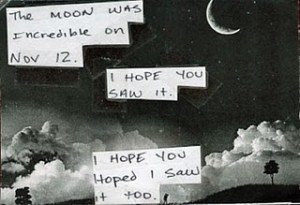
The postcard at the top of this blog I thought intriguing. It triggers a thousand stories.

The one on the left just resonated personally… I know. Pathetic, isn’t it?

On being a Townie…

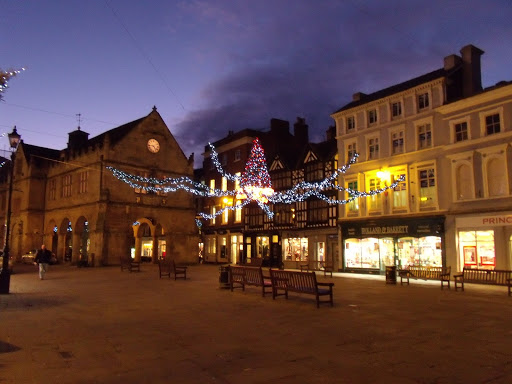
Having recently moved to the delightful town of Shrewsbury, I am a Townie again and it’s Grand.

Silence, broken periodically by the thunder of a milk-tanker passing the house at 80mph or a nearby cow in labour pain, has been replaced with the glorious revelry of Friday night drunks. Just now a party of hens has staggered by, singing badly but with commendable enthusiasm – an exultant symbol of Life (though I wouldn’t want their heads in the morning).

We can walk everywhere – river, park, shops, restaurants, theatre, school… in fact the latter is so close to the house that once I’ve taught my country bumpkin children a bit of traffic sense so they can see themselves over the road, I shan’t even need to get dressed until it’s time to nip to the Deli for elevensies.

I was, towards the end of our rural life, going quietly insane. Whilst village life and a small school were quite brilliant when the children were small, we’d all pretty much outgrown the Good Life and the negatives were beginning to niggle. I was utterly sick of the sight of green fields (I know, I know, it’s an awful admission) and the sound of silence, and it was a royal pain in the bum to have to get in the car just to buy bread.

We miss our lovely friends – though we’re not far away and they all have an open invitation – and the dogs miss the rats. But other than that, life here is just Grand. Of course, there is a potential downside: a person can’t spend much money in a shopless village, but in a town full of designer shops… Well. So far I’m being very good.

But last week I saw this gorgeous coat in a little boutique…

Stop the clock

I’ve been reading a lot lately, working my way through a selection of books bought for research purposes from the 3-for-2 table in Waterstones. These are six books I’d ordinarily not have chosen and so settling down with them isn’t quite the same as when approaching a new desired choice.

Having just finished one I found truly awful – I shan’t name it… it’s my opinion only – and feeling I’d wasted a few days persisting with that read, I reluctantly picked up the next on my list. It was Family Album by Penelope Lively – an author I’d not read before, having always assumed her to be writing for the kind of female who devours Woman’s Own magazine and things of such ilk.

So I was surprised to find it not only a wonderful story, and my sort of story, but a beautifully written one too. I enjoyed every carefully constructed sentence, loved the themes (which echoed my own favourites of perception, memory and its recall) and adored the old house in which the story was set. This crumbling Edwardian pile was as much – if not more – of a character as the people in the novel.

Using an inanimate object in this way is a powerful tool. In this instance, using an old house created both a strong, evocative setting and also served as a symbol of so much more. There were some glorious observations about what the house had ‘seen’ over the years – the memories and secrets imbued in its fabric, the effect it had on those who had lived there, its flaws and familiarities triggering happy and sad recollections wanted or not.

Having finished the book and not yet ready to start on the next, I was instead today inspired to write a short poem which reflects the echoes left in my mind from that last satisfying read – about time, place, memory and the desire, yet often inevitable inability, to escape the past.


Stop the clock

Turn off the lamp as you leave

Stop the clock

Sweep aside the whispers

And echoes of this game

Pack them up

Put them away

Stop the clock

Let dust settle on thoughts past

Leave faults to creak unheard

Unchecked

Drip

Drip

That which cannot be fixed

Shall remain broken

Stop the clock

Close the door

Walk away

~ Sandie M Zand, 25/10/10

Endings & Beginnings

There are days I wake and thank whichever god is currently in favour for the fact that I’m an Optimist. I’ve long been a devotee, but this month has seen a severe testing of that Faith.

Life usually balances fairly evenly on pillars of Domestic, Social, Work and Writing. Should one weaken or wobble, the others take the strain. And even if several start to crumble – leaving me precariously perched and in mortar-applying frenzy – there’s never a point at which all four would collapse simultaneously.

Or so I thought.

This month they did, and things going wrong induced much musing about endings and beginnings.

As part of this thinking I’ve considered my options with The Sky is Not Blue. I had a professional slating recently wherein I was told I don’t write well enough for the book to be a lit fic offering and yet whilst the writing is ‘good, better than many published books I could name‘ the storyline isn’t strong enough to suit the commercial end of debut fiction.

It hurt, but it’s true. Initially I thought about abandoning the book, starting something new, but I’ve decided to work on it for a little longer – weaving in more story – and have come up with some ideas worth pursuing. It means writing another 20-30k words and merging these with the existing story, but the end result ought to be a Better Book.

I’ve also agreed to help my dad with six non-fiction manuscripts, representing 40 years’ of his research. It took me a few weeks to mull over this request because it’s a huge project and a whole new area of study for me. But it’s fascinating. The main thrust of his work concerns Solomon’s Temple – beyond that I can’t say… it’s controversial, interesting and now I’ve agreed to help I’m quite excited.

The little film with this blog (http://www.youtube.com/watch?v=h5Mn8MVeZUE) illustrates the limbo in which I currently reside – as we wait for a date for our house move, as I adjust to various other changes both wanted and unwanted, as I gear myself up for yet another re-write of Sky, and also as I make some fairly significant work-related decisions…

Endings and Beginnings.

But do they exist as individual entities? Or are they points along the same line, overlapping as one context blends and transforms into another? I believe it’s the latter. They are one, it’s just a matter of perspective.

Few have discussed this better than T S Eliot:

What we call the beginning is often the end

And to make an end is to make a beginning.

The end is where we start from.

Optimism is the finest of mortars, is it not?

Love in an Elevator (till death do us part)…

I was flattered to be asked by the wonderful Year Zero writers to pen a short for the guest author slot on their website this month.

Anyone who hasn’t already checked out the shorts written by the Year Zero writers themselves is missing a treat – great stuff by fantastic writers. I’d recommend taking a good browse through their site.
Their events are a treat too – readings, live music, wine and good company… life doesn’t get much better than that.

York Writers’ Festival

Have been very tardy in blogging about this event, but I gadded off to another book-related social happening just a few days after York and have only now – a week later – recovered from the resultant hangover.

First, York…
This was a great event – made all the more so because I met up with Authonomy writing friends, some of whom I hadn’t met before. Between workshops, speakers, one-to-ones with agents and the bar, we hardly stopped for the whole weekend. Very tiring, but informative and great fun too.
On the Friday evening I took part in the Authonomy Live! competition. This consisted of standing on stage in front of 300+ people and reading an extract from my book. Given I’ve never read any of my work to another human being in person before (late-night, drink-fuelled film-making in my shed and reading out loud to the dogs don’t count) it was quite a nerve-wracking prospect.
But… I did it! And without making fool of myself too – which, given the amount of vodka and wine I’d consumed before taking to the stage, was a minor miracle in itself.
You can watch it here, along with the judge’s verdict:

Killing Darlings

I changed the title of my novel at last. It’s now called The Sky is Not Blue.

I think it’s a massive improvement on the old title (The Tipping Point) but several weeks on and I’m still instinctively thinking of my book under its old name. What can I say? I’m a creature of habit at the best of times. Eventually I’ll get used to this new, improved and relevant title.
It comes from a line in the book…
I’m not now sure whether I see Alice as a higher being, a person of such moral strength she can face Truth and look it in the eye without fear; or someone who’s just blind to her predicament, who occupies the same vacuous space as anyone else and finds meaning in each ingrained repetition and never contemplates what her purpose might have been, what anybody’s purpose might have been.

Or perhaps she just craves pain. Some people do.

She said she was rested, we could carry on. She said the view further along was breathtaking. She sounded like an advertisement. She looks across that void and only counts colours, shapes, the lack of concrete. She doesn’t hear the ancient screams lingering in the wind, doesn’t feel the water’s icy shock, the vile suck as Life is dragged down into darkness. The water is not blue. The sky is not blue. I’m not even sure the hills are green.

… but also reflects the novel’s key themes of perception, memory and how these deceive, as well as fitting with the ongoing artistic imagery throughout the story.
I’m happy with it – I just need to get used to it now!

The Night We Never Danced

From Thoughts from the Shed

I made another film. I’m not sure which is most fun, the actual filming (there’s something sublime about An Uninterrupted Opportunity To Talk) or the editing process.

It’s very much like writing – the initial creation of something and the editing to get it right.
And both elements are enjoyable in their own way. Getting an idea on paper is a buzz as is filming random waffle. But the post-writing/filming editing is possibly even more satisfying – hacking at a first draft, working up themes, crafting rhythm & pace for the written text; cutting out extraneous waffle, enhancing with music tracks, playing with effects, for the film.
In this film, I read a short story and talk a bit about characters and how they’re inspired (for me, that is – would be interested to hear how it works for everyone else).
Hope you like it..!